Introduction
Over the past twenty‑five years I have devoted myself to psychological astrology, guiding individuals in the exploration of their inner processes and personal development paths. I live in Argentine Patagonia and offer consultations both in person and virtually, serving people from various parts of the world.
In the previous decade, upon observing the planetary transits approaching for 2020 and their likely global impact, I developed a deep interest in mundane, financial, and business astrology. I sensed that we were entering a decade of profound transformations, particularly in this phase. It was then that I decided to analyze a cryptocurrency for the first time—a decision that represented a significant personal and professional challenge.
The same planetary archetypes I had used for years to understand emotional conflicts, vocational processes, or family dynamics now accompany me in researching market movements and collective economic trends.
This work marks my first serious attempt to apply my astrological expertise to the analysis of the crypto ecosystem. It is a learning journey in which I combine my training in astrological interpretation with the effort to understand how ecological and structural changes are reshaping the global economy and resource management.
Under this premise, I propose an exercise:
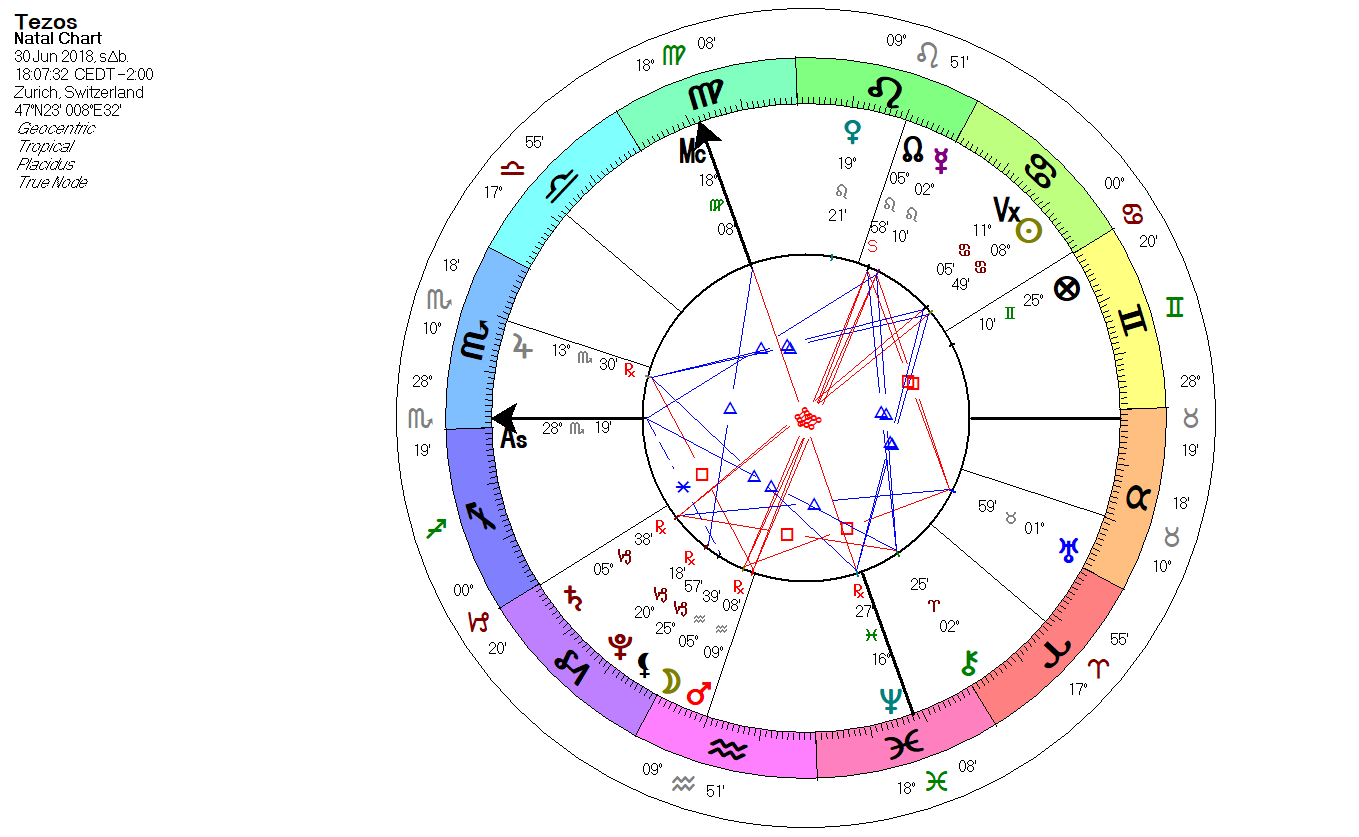
If Tezos were a person and we had to analyze its chart, an approximation of its description would be:
A reserved being with deep economic intelligence, oriented toward the protection and shared management of resources. It holds strategic financial power in silence, with a vocation for safeguarding what others cannot sustain. Possessing a community‑minded, rational—even scientific and innovative—mentality. It senses collective trends but keeps emotional distance. It prefers to observe rather than get involved. It responds to social logic, not to pathos.
Owner of a contained creative genius. It has a disruptive talent for building enduring systems, but within strict rules. It can be brilliant, yet not always flexible.
Let's listen to its inner voice. Imagine Tezos in session:
Pluto's imminent transit over its Moon would say:
"My community is changing. I am no longer who I was. It's not enough that they understand me logically... now they demand genuine emotion. Something in me must die for something new to be born. Perhaps I'll have to leave behind those who won't evolve with me."
- 🔹 Crisis in the way it relates to its community.
- 🔹 Reformulation of its social narrative, of its human foundation.
- 🔹 The need arises for real emotional and symbolic decentralization, not just structural.
Saturn's transits would express:
"I built a robust architecture. But now I feel it's no longer sufficient. They demand new rules, new ways to validate what I offer. My values are being challenged from the outside. And I must endure without breaking."
- 🔹 The solar self (purpose, inner leadership) feels limited, regulated, examined.
- 🔹 The economic model is under fiscal, accounting, and regulatory pressure.
- 🔹 It debates whether to preserve control or open itself to another way of sustaining value.
Uranus's ingress into the 7th house would demand:
"The relationships that once defined me no longer represent me. I can't keep signing contracts that bind me to a past that no longer resonates. I need freer, more flexible, visionary relationships. And I know that also brings rupture."
- 🔹 The type of partners it chooses changes radically.
- 🔹 Possible legal or contractual conflicts with old structures.
- 🔹 It opens space for modular alliances, DAOs, more open and interoperable frameworks.
Psychological Diagnosis 2025–26
Tezos as a person goes through its first great crisis of institutional identity:
| Field | Crisis | Possible Renewal |
|---|---|---|
| Leadership & Purpose (Sun) | Questioning its closed economic model; need to reinvent its raison d'être | A more collaborative redefinition, focused on the public good |
| Institutional Ties (7th House) | Fracture or exhaustion of rigid, formal alliances | Entry into agile, technologically dynamic partnerships |
| Community & Narrative (Moon) | Coldness and emotional distance no longer suffice | Cultivating warmth, emotional connection, and experiential storytelling |
| Economic Structure (Saturn in 2nd House) | Gap between what it sustains and what the world now demands | Adoption of sustainable, fiscal, ecological, and more open models |
Who Is Tezos in 2025–26?
Tezos is a brilliant, reserved, and highly structured being, undergoing an unprecedented emotional and contractual revolution in 2025–2026. Everything it has built through pure reason must now be woven into a new, collective, emotional, and transformative narrative.
It has the opportunity to become a post‐institutional public infrastructure — but only if it sets aside its technical pride and learns to resonate emotionally with the world it aims to serve.
Now let's approach this from the technical side:
Technical Approach to the Astrological Analysis
It's crucial to recognize that we are embedded in broader processes that provide context—processes generated by recurring cycles. Each natal chart responds to these universal rhythms according to its own signature. Therefore, I will first explain the preceding cycles briefly and then study that dynamic applied to Tezos's chart.
Initially, we focus on the waxing square (tension/activation phase, between 90° and 95°) of the Jupiter–Saturn synodic cycle, which spans roughly 20 years and establishes our social, cultural, and financial backdrop.
The square phase falls about 4–6 years after the conjunction (2020), and typically heralds institutional crises, regulatory shifts, or new financial architectures born from tensions between expansion (Jupiter) and restriction/structure (Saturn).
Previous Examples
1. Waxing Square 1986
- Previous conjunction: December 31, 1980, in Libra
- Exact waxing square: April 2, 1986 (Jupiter in Pisces 9°, Saturn in Sagittarius 9°)
Relevant Financial Events of that Square:
This waxing square launched a tsunami of deregulation, favoring aggressive credit expansion and radical financial transformations, but at the same time generated severe bank failures, asset bubbles, and structural tensions:
- The removal of interest rate limits in the U.S. planted the seeds for more aggressive but also more fragile banking.
- The British Big Bang made the market global and hypercompetitive, incentivizing rapid growth and systemic risk.
- The stock market and derivatives boom came accompanied by hidden risks, which later translated into severe falls and restructuring (literally hundreds of banks closed in the U.S.).
This period is paradigmatic of what financial astrology sees as the dual effect of the square: structural contraction (Saturn) stimulates an unbridled increase in expansion (Jupiter) without adequate controls, leading to crisis.
In summary, the 1986 waxing square generated an explosive configuration: global financial flows were liberalized, a new stock market and institutional architecture emerged, and banking crises were unleashed due to excessive leverage and uncontrolled innovation.
For any financial astrologer, this phase exemplifies how Jupiter-Saturn cycles can trigger profound transformations in economic systems, modern both in technologies and policies, but always at the cost of exposing structural fissures that must later be repaired.
2. Waxing Square between December 2005 and October 2006
- Previous conjunction: May 28, 2000, in Taurus
- Exact waxing square: Three hits between December 2005 and October 2006 (Jupiter 10° Scorpio / Saturn 10° Leo)
This aspect was part of a larger cycle of fixed tensions, also involving Mars and Neptune, forming a grand "fixed T-square" between late 2005 and 2006.
In financial astrology, it represents a battle between aggressive expansion (Jupiter in Scorpio) and rigid institutional control (Saturn in Leo), associated with confidence crises, value readjustments, and institutional restructuring.
Relevant Financial Events:
- Jupiter in Scorpio (mortgages, debt, secret leverage) incentivized aggressive and emotional credit expansion, without transparency.
- Saturn in Leo (authority, public management, the symbol of value) tried to impose limits, but was ignored or bypassed, generating an explosion of hidden risks.
- The result was a weakening of the global financial structure, with compromised liquidity and confidence crises.
In summary, 2005-2006 is a perfect example of how these squares—a process of application and testing of models born in the 2000 conjunction—can generate both financial innovation (complex instruments like CDOs) and systemic failures due to overconfidence and lack of limits.
Current Situation - Ongoing Waxing Square (2024–2025)
- Previous conjunction: December 21, 2020, at 0° Aquarius
- First waxing square: Three hits between August 2024 and June 2025 (Jupiter in Gemini, Saturn in Pisces, and Jupiter in Cancer/Saturn in Aries)
The important square between Jupiter in Cancer and Saturn in Aries highlights a clash of very different forces: on one side, Jupiter in Cancer seeks to expand and protect whatever it deems valuable at a collective level—well‑being, family, community, the state. On the other, Saturn in Aries demands immediate action, rapid decisions, drastic cuts, and a vertical, almost wartime style of leadership.
When these two planets come into conflict, the result is typically a tug‑of‑war between the need to nurture and the imperative to act. In financial and political terms, this can manifest in several emerging scenarios. For example, strong tensions are very likely to appear between governments—which want to increase social spending, invest in public programs or sustain subsidies—and central banks or financial entities that are concerned about inflation, deficit, or fiscal discipline. This difference in criteria could generate open debates and even power clashes. It wouldn't be unusual to see abrupt fiscal reforms, announcements of budget cuts, or tax increases on concentrated sectors as a form of compensation.
Another important front is that of digital currencies. During this period, pressure will grow to launch official digital currencies—the so-called CBDCs, which are issued by central banks—with the argument of providing more control, traceability, and security to the financial system. At the same time, the debate over the regulation of crypto platforms and private stablecoins will intensify. Some could be left out of the game if they don't adjust to new rules. We will possibly see restrictions, controls, and even sanctions on decentralized actors who until now operated without too much state intervention.
Added to this is a climate of profound reforms. Many institutional structures—whether banking, state, or even social programs—could be forced to reconvert or close. There will be tough decisions: mergers, layoffs, redefinitions. All in the name of efficiency, control, the need to act quickly in a changing world.
However, behind these technical decisions, there is also an emotional impact that cannot be ignored. The population could begin to feel unprotected. The tension between speed and care can generate a sense of abandonment: that the systems that promised containment are now reacting with coldness or urgency, but are not listening. This can lead to an increase in protests, institutional distrust, or the growth of alternative community initiatives that seek to recover that human dimension that the official apparatus cannot sustain.
The square between Jupiter and Saturn does not mark a collapse, but it does mark a crossroads. Between June and October 2025, many economic and institutional models will be put to the test. Those that manage to offer care without being paralyzed, and action without becoming authoritarian, will be able to advance. But those that try to move only with force or only with idealism, without integrating both poles, could break or lose relevance.
In simple terms: we are heading toward an era in which society will demand institutions that know how to care and act at the same time. The tension between these two mandates will define the course of the coming years. And those who cannot embody that balance will be left on the margins of history.
The 2025 square will test whether decentralized institutions can serve as beacons of trust in a tense, fast‑paced world with no margin for error.
Tezos has an opportunity in 2025: to be chosen for its maturity, sobriety, and governance.
But to seize this moment, it must reframe its emotional voice, tell its story in human terms, and shed any technical coldness that prevents it from resonating with the collective need for security, belonging, and support.
How does this impact an ecosystem like Tezos?
How This Impacts an Ecosystem Like Tezos
We will attempt to weave together three key layers of financial‑astrological analysis:
- The third and final waxing square of Jupiter–Saturn (2025)
- The ingress of Uranus into Gemini (July 2025, first entry)
- The global crypto‑regulation process (MiCA, SEC, BIS, etc.)
And we will try to apply it to a very particular ecosystem: Tezos—a blockchain that has never followed the same speculative script as many other projects, but has from its inception carried a structural, legal, and technical vocation.
Astrological Starting Point
The Third Jupiter–Saturn Square (last of the cycle):
- Exact date: June 16, 2025
- Jupiter in Cancer 1°, Saturn in Aries 1°
This aspect represents the final summons to restructure everything left unresolved since 2021, occurring in cardinal signs of initiation (Aries) and public support/emotion (Cancer), therefore generating firm decisions and broad social effects.
It is the first major tension since the conjunction of December 2020 (0° Aquarius). By occurring in cardinal signs, this square symbolizes conflicts between new structural initiatives and the expansion of sensitive or populist systems. It can also mark a decisive break in global financial policies, especially in the field of:
- Digital currencies (CBDCs)
- Regulation of crypto assets
- New fiscal or institutional architectures
Additionally:
Uranus enters Gemini on July 7, 2025: opens a seven‑year span of radical technological innovation in communication, smart contracts, exchange protocols, and the very grammar of digital money. This activates a wave of disruption over financial and communication structures, especially those too slow or centralized.
Why Tezos Is a Special Case
From my study, Tezos is not merely a speculative token. It has several features that make it highly relevant at this stage:
- Proof‑of‑Stake from inception (before Ethereum): making it more eco‑friendly and aligned with ESG regulatory standards.
- On‑chain governance: one of the few ecosystems where upgrades are proposed, voted on, and executed without hard forks. This directly echoes the Saturn–Uranus symbolism: structured, integrable change.
- Clear legal framework: since its Swiss origins with the Tezos Foundation, it has sought to comply with Swiss and European regulations. This makes it compatible with MiCA and future international legal regimes.
With the final impact of the Jupiter-Saturn square and the ingress of Uranus into Gemini, the Tezos ecosystem can benefit:
- From a symbolic and technical revaluation as a "legally mature" blockchain platform.
- From its profile compatible with European MiCA regulation, prioritizing traceability, identity, energy efficiency, and governance.
- From the shift toward more auditable and automated smart contracts, where its formal system and Michelson language offer a competitive edge.
However, it should take into account:
- Possible loss of mass‑market attention, since it is not a "trendy" blockchain, potentially affecting liquidity.
- Emerging competition from sovereign, publicly backed blockchains, such as BRICS L1s or projects based on Cosmos or Substrate.
- Uranus in Gemini may scatter focus toward new modular, post‑layer‑1 blockchain models, where Tezos will need to adapt.
- The exact cardinal square (0°) impacts Tezos as a call to reinvent its guiding principles and structural narrative.
- The project must balance growth needs (Jupiter) with the formal discipline demanded by the new global financial framework (Saturn).
During this time, natal Mercury at 2° Leo is the most activated point: if Tezos finds a fresh way to communicate, document, and educate about its technology, it can turn this tension into a strategic quantum leap.
Until now, Tezos has defined itself—and has been perceived—as a project focused on technical solidity, formal security, and institutionalized governance. Its identity has been anchored in offering a serious alternative, designed for the long term, with solid formal foundations in the face of the volatility of the rest of the crypto ecosystem. That narrative, although coherent, has resulted in part hermetic: useful for developers, academics, and regulators, but distant from the common user, from the community, even from the cultural narrative that moves the market.
Now, with the square between Jupiter and Saturn opening a new global stage of structural demand, and with Uranus entering Gemini—a sign linked to multiplicity, connection, and adaptability—Tezos needs to translate itself. It's no longer enough to be correct: it must be comprehensible, desirable, inspiring. Its narrative must evolve from "we are formal and efficient" to "we are trustworthy because we understand the world to come".
This does not imply betraying its technical essence. It implies better telling its reason for being, not just with papers or protocol improvements, but with a story that brings it closer to society's real challenges. It needs to show how its governance model can help communities make decisions, how its traceability can protect rights in digital legal systems, how its energy efficiency can be part of a regenerative financial infrastructure, and how its modular architecture can be a foundation for building trust between parties who don't know each other.
The structural narrative change being asked of it is not cosmetic: it is existential. It means moving from talking to engineers and regulators to speaking to citizens, creators, institutions, and human networks. It means opening the narrative toward the symbolic, the emotional, the ethical. It means stopping presenting itself as "the most logical" and starting to show itself as the most prepared to sustain the future when everything else becomes unstable.
Because in a world where everything changes—where blockchains fork, systems fragment, and rules are rewritten—those who offer solidity without rigidity, and evolution without opportunism, may become the cornerstone of a new era.
Uranus Enters Tezos's 7th House (July 2025 and remains 7 years)
7th House governs strategic alliances, contracts, legal partners, counterparties, visible adversaries. Uranus's ingress (innovation, disruption, decentralization) into this house indicates possibilities such as:
- Break with previous alliances
- New non‑hierarchical and non‑traditional collaboration models
- Potential legal conflicts with state or corporate entities over rigid frameworks
Tezos may be forced to review its B2B contracts and partnerships, including arrangements with governments or banks. Unexpected, experimental alliances may emerge—with DePIN players, decentralized AI networks, or tokenized environmental projects. There is a risk of rupturing established relationships if they fail to adapt to new ethical, technological, or legal standards.
Example:
If Tezos holds contracts with traditional financial institutions to issue tokenized assets, Uranus could trigger abrupt regulatory changes (e.g., new AML/KYC requirements), forcing renegotiation or termination.
In Summary
Tezos, due to its formalist, energetic, and legal structure, can position itself as one of the major winners in the 2025–2028 era, when crypto regulation becomes indispensable for interoperability with central banks and state systems.
The key will be in:
- Institutional alliances (CBDCs, regulated DeFi, stablecoins)
- Educational and cultural innovation about its governance model
- Not losing the adoption race in the real world, beyond legal "compliance"
Other Transits to Consider
Saturn Square Transit to Natal Saturn (Cap 5°38′) and to the Natal Sun (Cancer 8°49′)
Key period: Saturn enters Aries in May 2025 and forms exact squares to natal Saturn and then to the Sun between May and July 2025, repeating between February and March 2026 (due to retrograde and direct stations). Nature of the aspect: Saturn transiting natal Saturn: the first waxing square—equivalent to a "structural test"—marks a raw evaluation of the internal architecture.
Saturn square the Sun: pressure on the system's core—its technical leadership or economic vision. This is a transit of high financial and identity tension.
Natal Saturn in 2nd House (Capricorn): Represents the assets supporting the ecosystem—its economic model, reserves, and structural sustainability. In Capricorn: security, control, regulatory compliance, slowness. Natal Sun in 8th House (Cancer): Symbolizes shared resources, joint investments, financial partners, and the institution's deep identity.
In Cancer: custodian, protector, oriented toward containment and security.
Therefore
Saturn's square pressures Tezos's revenue structure and legitimacy. This may imply:
Forced revision of the economic incentive model (staking, baking)
Legal/fiscal uncertainty in jurisdictions where it operates
Conflicts with financial allies if contractual terms become unsustainable or clash with new regulatory frameworks (MiCA, FATF, etc.)
Risks and Opportunities
| Aspect | Risk | Opportunity |
|---|---|---|
| Uranus in 7th House | Break with previous legal or B2B alliances | Creation of new DeGov/DAO partnerships or flexible legal contracts |
| Saturn square natal Saturn | External audits, extreme pressure for regulatory compliance | Sustainable accounting and financial redesign, compatible with MiCA / Basel III |
| Saturn square the Sun | Crisis of confidence in institutional leadership | Vision reformulation: from technical blockchain to "trusted public infrastructure" |
General Conclusion
2025–2026 is a critical cycle of institutional maturity for Tezos, comparable to a "fiscal year of structural judgment."
If it fails to adapt:
It may experience loss of strategic alliances
Blocks in key jurisdictions
Market doubts about its real economic model
But if it responds with a legal framework update and progressive contractual redesign, the Uranus transit to the 7th House and the Saturnian squares can become a crucial repositioning as stable infrastructure in a chaotic financial world.
Tezos Astrological Chart